


kushiro
-
Posts
1,914 -
Joined
-
Last visited
-
Days Won
15
Everything posted by kushiro
-

The FA Cup Goal Kings - and What They Did To Leicester
kushiro replied to kushiro's topic in Leicester City Forum
Were you there at that WImbledon game in 2003 when the crowd at the Walkers Stadium voted on Jon Holmes' idea of changing the name back to Fosse? -
The FA Cup Goal Kings - and What They Did To Leicester
kushiro replied to kushiro's topic in Leicester City Forum
So we lost to Kettering three years out of four - and in the middle of that we were knocked out by Southampton, then in the Southeern League. So in fact it was four seasons in a row that we lost to a non-League club. It took us a while to get the hang of this FA Cup business. -
The FA Cup Goal Kings - and What They Did To Leicester
kushiro replied to kushiro's topic in Leicester City Forum
That 1976/77 FA Cup season was totally iconic for me, thanks partly to the book Journey To Wembley, in which journalist Brian James started in the Preliminary Round at Tividale and went all the way through to the Final. It's done all the time now of course but I think he was the first to do it properly. I got the book when I was 13 and I must have read it all the way through about five times. -
Okazaki interviews, comments and pictures from the Japanese media
kushiro replied to kushiro's topic in Leicester City Forum
The Shinji retirement news is causing quite a stir here - on Yahoo Japan there are over 500 comments. Here's a sample, run through google translate: I loved the way he played aggressively, and prioritized the team's victory over his own points, as it really reminded him of a samurai. I'll never forget his scoring ability in Germany, his miracle in England, and his overhead shot. Although it became rare for him to score goals in Spain and Belgium, he still continues to play in matches while changing positions, probably because his IQ and attitude have been recognized overseas as well. At the end, I wanted him to go back to Shimizu and see Japan again, but thank you very much for your hard work. In my opinion, he is the No. 1 striker in the history of the Japanese national team. There are few players who can do as much for the team as Okazaki. Despite coming up from the bottom with Shimizu and playing an active role as a goal scorer in Germany, what was required of him at Leicester was his dedication to running. However, even though his role changed, his pride did not get in the way and he continued to contribute to victory. At that time, the front line players who were in the spotlight were Vardy and Mahrez, who had good numbers, but he was the one who chased the ball more single-mindedly than anyone else. It was shining. There's no ally who doesn't get energized by seeing him. Thank you very much for your hard work during your long career. -
The FA Cup Goal Kings - and What They Did To Leicester
kushiro replied to kushiro's topic in Leicester City Forum
Here's that Daily Mirror piece on Dougan and Glover enlarged and hopefully readable: -
Okazaki interviews, comments and pictures from the Japanese media
kushiro replied to kushiro's topic in Leicester City Forum
You're right. That interview was quoted on this thread - it was from Shinji's diary of the season, that he published in Japan, translated by yours truly and posted here four years ago (it's on page 29 of this thread). Part of the reason for wanting to talk to him is to get over to him just how loved he was (and still is) by City fans - and just how valuable a role he played - in the opinion of most supporters - in that title win. -
The FA Cup Goal Kings - and What They Did To Leicester
kushiro replied to kushiro's topic in Leicester City Forum
After such a sorry tale it's good to know there is at least a crumb of comfort to be taken from the Kettering FA Cup story. Two of those record 912 goals in the competition were scored by this man: Younger readers may not recognize him but that's Derek Dougan. He was at Filbert Street for just a short time in the 1960s but it's no exaggeration to say that at that time he was adored by Leicester fans just as much as Jamie Vardy has been these last ten years. At the end of his playing career he joined Kettering Town, where he had total control of the club both on and off the field - the first person in history, or so he claimed, with such complete authority. They were the first English club to wear a sponsor's name on their kit, in 1976 - as you can see. They hadn't bothered to ask permission from the FA before they did so, and the authorities predictably stepped in and cried 'foul'. The resultant publicity was, of course, exactly what the club and Kettering Tyres, had banked on - a foobtalling version of the 'filth and the fury' pantomime that gave the Sex Pistols such a boost later that year. On November 6th 1976, Kettering drew 1-1 at Darlaston in the FA Cup 4th Qualifying Round - and it was Dougan who got the goal - at the age of 38, a year older than Jamie Vardy is now. That would have been, at a wild guess, about the 600th goal Kettering scored in the competition. Kettering won the replay, and just like those victories over Leiceter Fosse back in the day, that took them into the First Round Proper. There they created another shock by winning at Oxford United, Dougan with the crucial goal again. In Round Two, they were drawn against fellow non-Leaguers Tooting and Mitcham United, and for this tie Dougan left himself out - but brought in his new signing. This was another Leicester City legend: Lenny Glover was still only 32. Kettering won that 1-0, and they were in the hat for the excitement of the Third Round draw, with the whole country listening on the radio. Sadly, the romance ended there. Instead of a dream re-match against Leicester, 80 years on, or a tie against any of the other big clubs, they got a home game against Colchester United. They lost that 3-2, and the Doog / Lenny fairy tale was over. It wasn't just the Cup run that was over. A few days before that Cup defeat they had lost for the first time in the League that season - yes, unbeaten until early January in all competitions. They had seemed to be cruising to the Southern League title, and another shot at election to the Football League. They'd already come close in 1974, 1975 and 1976 - and surely they'd do it this time. But with the Cup exit their League form dropped off too. They finished down in third place, and champions Wimbledon were the club whose name went into the ballot at the Football League AGM. They were voted in, with Workington the first team booted out since Barrow five years earlier. The Doog soon moved on, and the golden days were over. They were free to go on walloping the minnows in the qualifying rounds for evermore. But they have never fulfiled that dream of making the big time. They're currently in the Southern League Premier Division - even lower than Maidstone. Who knows, maybe someday the Poppies wil make it. -
Before each round of the FA Cup I've been writing a piece about the history of that fixture. So far we've had Millwall in Round Three and Birmingham City in Round Four. But now with Bournemouth it's a bit different. We've never played them in the FA Cup before. So I'm going to tell a different kind of FA Cup tale - though this one's a bit of a horror story. Let's start with a quiz question. Which team has scored the most goals in the FA Cup? Not just this season, but across the whole 153 year history of the competition? The answer is a bit of a surprise. It's Kettering Town. A bizarre stat, but when you consider the age of the club, and the round at which they traditionally enter, maybe it's not really that surprising. They've had the chance to wallop the minnows in the qualifying rounds since they first entered back in 1890, and unlike other senior non-League sides, they've never made it into the Football League (a step which takes away that opportunity for walloping). Their goals total now stands at 912, one ahead of Tottenham Hotspur. And while that may give us yet another chance to snigger at Spurs' perennial also-ran status, we can't really crow - not when you look at our FA Cup record against Kettering. It's pretty shocking. In fact, it is probably the worst record of any League club against a non-League side in the history of the competition. The squeamish may want to look away now. Here are the sordid details: December 14th 1895 . FA Cup Qualifying Round. Leicester Fosse v Kettering Town. This was our second season as a Football League club, but we were still required to go through the qualifying rounds of the 'English Cup', as it was then called. We had beaten Hinckley Town, Hucknall St.Johns and Kimberley already, and now we faced Kettering Town of the Midland League at Walnut Street, as it was then called. Enzo Maresca would have approved of our tactics in the late Victorian era. We played a patient, passing game - but it was a style that didn't please everyone. The local press described it as 'fiddlin' and finnickin', and fans who prefered a more direct approach no doubt had other words for it. Kettering came to Leicester for this Cup tie and countered our approach with 'the long kicking methods of the Midland League'. On a mud bath of a pitch in December their style was more effective. Leicester attacked the 'Gasworks End' in the first half, but after just five minutes, Kettering took the lead. We got level with a Harry Trainer goal, but before half time the non-Leaguers went back in front. After the break we attacked the Town end, but conditions got worse, and with Kettering full back Draper 'displaying his well-known fouling proclivities', we were frustrated. The match finished in a 'severe storm' with Kettering holding on for a famous victory, They were in the First Round proper, where they would lose to Newton Heath. January 2nd 1897. FA Cup Fifth Qualifying Round. Kettering Town v Leicester Fosse A year on and after beating Wellingborough and Bulwell, we drew Kettering Town again and had a chance for revenge. That didn't happen though. The match followed exactly the same pattern as a year before. We were 2-1 down at half time and couldn't force an equaliser after the break. This was the reaction of the Leicester Mercury; The defeat was received with keen disappointment, not to say disgust, in Leicester. It was a pity that time should have been wasted in witnessing such a miserable attempt at football. The players were as fit as they should be, yet some of them would not exert themselves sufficiently to turn a hair. The ground was hard, and falling was dangerous, but if Kettering could take the risk, why not Fosse? The players have descended to the depths of ignominy. So once again it was the Midland League side that went through to the First Round proper - and once again they lost at Newton Heath. December 10th 1898 FA Cup Fifth Qualifying Round. Kettering Town. v Leicester Fosse Two years on and the sides were drawn together again at the same stage of the competition. Third time lucky, surely. We were on a run of seven straight wins in League and Cup that had taken us to third place in Division Two and past Kimberley and Rushden in the qualifying rounds of the Cup. But at Kettering's new Rockingham Road ground it was the same old story. They used 'pulverising methods' while Leicester tried again to play their patient passing game. It didn't work. ''Whenever they fiddled with the ball they were knocked off it by the Kettering half backs', said the Leicester Daily Post reporter. Once again we were behind at the break, though this time we managed a second half equaliser, Bernie Fulwood's goal forcing a replay. On the following Thursday afternoon it was 1-1 with time running out when a player called Herbert Winterhalder headed past Fosse keeper Arthur Howes and - unbelievably - the non-Leaguers had done it again. They were in the last 32, though once more that was as far as they got - they lost at Notts County. So that's the story - three times we've drawn them in the Cup, three times we've lost. Probably the worst record for any League club against non-League opposition (unless you know different). Just a bit of context, though. The concepts of 'league' and 'non-League' were a bit different then. There were only 36 teams in the Football League, so there were a lot of strong teams outside it. One of them, our old friends Tottenham, actually won the competition a couple of years after these Kettering exploits, and another, Southampton, were twice finalists. So it wasn't quite the same level of shock, for example, as Harlow Town beating us in 1980, or Maidstone winning at Coventry tonight.
-
Okazaki interviews, comments and pictures from the Japanese media
kushiro replied to kushiro's topic in Leicester City Forum
Reports in the Japanese media this morning that Shinji will retire at the end of this season. He's just turned 38 and isn't getting much of a look in with St Truiden in the Belgian League this season. I think a lot of people were expecting him to come back to Japan and continue playing into his 40s, as so many have done. I really hope he comes back as on my bucket list is interviewing him - sitting down with him and going through the 2015/16 season match by match, showing him the key moments and getting his reflections. -
It was great to see this table in John Percy's interview with Maresca - looking back over the whole history of the second tier and not just the modern era. That 1905 Bolton team only had two more games to play at that stage - and they lost one of them, which knocked them down the list a little. I would rank that 1906 Bristol City season as the best ever. How good was it? Well, even if we win our next six, we will still only equal their record after 38 games (which is where their season came to an end). To beat their points per game record across the whole season we need to total 117 points - which means 39 points from the remaining 14 games - winning all but one, basically.
-
Gordon's guest apperance on Jon Holmes' podcast has finally turned up. He speaks so well all the way though. Football Ruined My Life - Jon Holmes, Patrick Barclay, Colin Shindler, Paul Kobrak | ポッドキャストランキング (podcastranking.jp) You'll hear Gordon's surprise when Paddy Barclay talks about Tom Finney being tired the night before the 1954 Cup Final. His surprise is well-founded. The awards ceremony Paddy talks about was actually on the Thursday night.
-
When I was talking to Gordon about his career the name of Charlie Woods came up. When Bobby Robson was appointed Newcastle boss in 1999, there were two people he wanted alongside him - Gordon Milne and Charlie Woods. That wasn't a name I was familiar with but it turns out he was a key figure in the Ipswich set up in the 1970s and 1980s - Bobby Robson's Youth Coach. I told Gordon that he seemed the kind of behind-the-scenes figure it would be worth finding out more about - and he told me Charlie was a healthy 82 year old now living in Gosforth. He put me in touch with him and we had a chat last week. He had a pretty fascinating career and I've put a piece on the Ipswich site about him. Forum | Charlie Woods - Ipswich Legend by kushiro | TWTD.co.uk
-
Of all the comments on the other clubs' forums, this was my favourite, from red and white kop, the Liverpool site:
-
Over on the Bentley's Roof forum the guy in the cap has been identified as 'Brian' - would love to hear any other memories of him.
-
Confession time: I've been playing away. Gordon was kind enough to speak to me on several occasions over the past few weeks. Having researched the careers of him and his father, I knew that there was an awful lot to talk about - and I wanted to ask him in detail about every chapter of the story. I also wanted to post a review on the forums of every club that Gordon and Jimmy had played for or managed - yes, even Coventry City. It's weird - there are some forums that I found very difficult to sign up to - not sure if it's because I have an overseas address. I started getting paranoid, thinking there was some great security system, preventing fans of different clubs registering on other forums - like the powers-that-be are terrified of what might happen if we all started working together for the rights of the supporter instead of just hating each other all the time. But as I say, that's just my paranoia. Thanks to some sterling assistance from @Plastik Man I managed to sign up to all the different forums. For each club, the piece is written from a different perspective. Here they are - it was great to get comments about Gordon's career from fans of all those clubs . The Liverpool one is the best, I think: Liverpool: Gordon 1960-67 The Quiet Man Speaks At Last (redandwhitekop.com) Blackpool: Gordon 1967-70 https://avftt.co.uk/index.php?threads/gordon-milne.48639/ Preston: Jimmy 1932-1968, Gordon 1955-1960 https://www.pne-online.net/forum/index.php?threads/from-father-to-son-the-key-moments-in-four-decades-of-drama.3439029/ Coventry: Gordon 1972-1982 https://www.skybluestalk.co.uk/threads/gordon-milne-highlights-of-a-remarkable-career.155165/ There's also Wigan, Morecambe and Dundee United - but I think you get the picture.
-
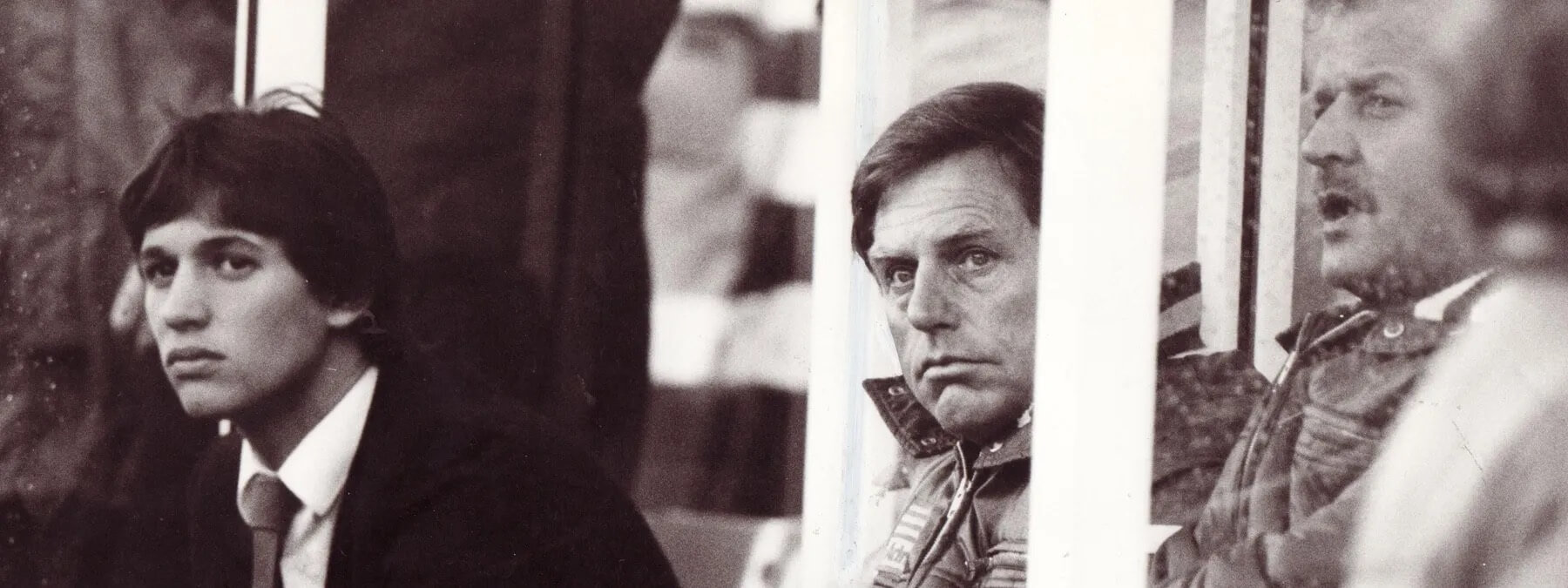 On the weekend before his autobiography 'Shankly, My Dad and Me' was published I spoke to Gordon about his career: ************************************ It's great to speak to you, Gordon. You've been a big part of my family's life. My father was from Liverpool and he used to watch you at Anfield in the early 60s. Then he moved to Leicester, where I was born, and I used to watch your team at Filbert Street in the 80s - from the Main Stand Enclosure, about twenty yards from your dugout. Ah - you weren't one of that group who used to barrack me all the time? Not me, no! But actually, right next to where I stood there was this group of old Leicester characters who spent the whole game making wisecracks. They were pretty funny. Wait a minute, I'll send you a picture. Do you recognize them? I don't think they were the ones who barracked you. They didn't have that mean streak - they were just having a laugh. The guy in the cap looks familiar! I read that your first visit to Filbert Street was back in the 50s when your dad was trainer at Preston, and they came down to play Leicester. You said you were in the Double Decker. Yeah - the reason I know that is I remember my dad running on to treat someone at that end - the Double Decker end - and he passed behind the goal on the way back, and he was getting abuse from the fans behind the goal. I always remember that. As a player at Preston back in the 1930s, your father was nearly chosen for Scotland, then the war intervened. You later played for England. When you were growing up in Preston, did you feel Scottish or English? Without a question. Scottish. It’s funny this. Before the war, my Auntie Grace came down to live with my parents in Preston. So there were four in the household, and three were Scottish. All my aunties and uncles were Scottish and most were football daft. The only noise I heard was Scottish noise. When that England-Scotland fixture was played my relatives were on the phone from Dundee saying we’re gonna do this and we’re gonna do that. When your father was the trainer at Preston, he was chosen to do the same job for the Football League XI, wasn't he? And at that time those fixtures were quite prestigious - they were like a trial for the full England team. Did that make it easier for you when you were selected for England, that he'd already kind of moved away from that purely Scottish identity? We should have had had this conversation 12 months ago, I could have put this in the book! Yes, he was very proud of being selected as trainer. I still have the photo of that game. Looking back now he missed the 1938 final through injury, then the war came along, then he studied physiotherapy and got the qualification he needed, then came the Football League job and taking Preston to the Cup Final in '54. So your father was trainer at Preston, and you started your career there, but then you felt you needed to move away from him. You didn’t want any of those complications. You wanted to stand on your own. When I was there with my father I was only part-time. For two years I was doing my apprenticeship. There would be odd occasions when I trained with the first team but that would be very rare. I felt the pressure then. Then I went into the army for two years. I knew that when I went full time I didn’t want to be in that scenario. It didn’t seem right for my dad and for me. I think it’s quite natural. When you were a manager later, did you ask his advice? I don't know if it was a different generation but the relationships of fathers to sons were - you just get on with it, learn from your mistakes. Trying to have long conversations with your father was a bit unusual. When we were younger, he’d been in the police force and had been through the war. I wouldn’t say fear, but it was respect. He was not an easy act to follow - there was always that in the background. Tell us about that extraordinary moment when you and your wife Edith first met. It was me and David Kerry, another young Preston player. We were playing tennis one night - two young footballers so we think we’re the bees’ knees, poncing around. We saw these two girls playing on another court, and as you do, we were having a look and saying ‘They look alright!’ and their names were Edith and Barbara. It led to two weddings. David and Barbara were still together until a few years ago when he sadly passed away. Reading interviews with you in the late 60s you said that your favourite game for Liverpool was Leicester away in 1964, in the League. When the bogey was finally laid. When people saw that Easter programme, no-one gave us a chance. We were going for the title - Shanks' first title - and United and who else was it, in the race? (Spurs and Everton) - and we had Spurs away on Good Friday, Leicester away the next day then Spurs again at home on Monday. No-one gave us a chance. I picked up an injury at Spurs and it was touch-and-go for Leicester. We were in the Grand Hotel in Leicester on Friday night and Bob Paisley was trying to get me fit. In those days you played a lot when you weren't 100%. It was 'Let's see how it goes, do your best'. And I played, and we won 2-0, then we beat Spurs again on the Monday. With Leicester, people called them our bogey team, and there was that semi-final where we absolutely battered them but coudn't score past Gordon Banks. But really it wasn't a surprise that Leicester had those good results against us. They were a great side at the time. When you made your England debut against Brazil, you almost scored in the first twenty seconds when that shot was saved. What a start that would've been. My son says it was a back pass! (A reminder of that moment): You didn't make it into the final squad in ‘66, but you had so many great players competing for those positions in the mid-60s - Venables, Ball, Peters, Tony Kay of Everton... Tony Kay to me personally was my biggest rival. He had the same style as me. He got into trouble later, didn't he. In 1966 I knew I wasn't at the level I had been. I got that injury before the Cup Final and it took me a long time to recover. Other players were emerging and I was standing still or going backwards a bit. I never felt I’d let myself down in an England shirt, but the recovery period after the injury – it took me longer to get back to where I was. What was more surprising was that Peter Thompson didn't make it. In my eyes, Peter was flying at that time. There was that drive back to Liverpool from Lilleshall after the squad was announced, with five Liverpool players in the car. Roger, Cally, Gerry Byrne - they were in, then me and Peter who were out. A report came on the car radio about the squad and Roger turns it off. After that, we hardly said a word. Then there was Jimmy Greaves. I wasn’t in the squad but for Jimmy it was worse. He was in the squad, and when he didn’t make the final, that killed him. Do you remember where you were for the Final? I watched it, but I can’t remember where I was. That could be the reason – not wanting to watch it, in a way. So sick that you’re not there. You missed out then but I don’t think there’s any doubt that, as a manager, you had more success than any of those who were chosen in Ramsey’s final 22. You could look at Alan Ball maybe, and Jack Charlton of course, but in terms of trophies, no-one can rival you. It’s never even crossed my mind that. Now that you mention it, it’s interesting. I can’t wish for any more from my career. Of course, there were disappointments, but the longevity of it all is something I look back on with pride. Even the time at Coventry City. I mean, there were no trophies, but keeping them in Division One for nine seasons has to be counted as a success. Well, that was the mandate. Produce kids, sell them and stay in Division One. It was a mandate you couldn’t really publicize to the fans because they don’t want to hear that. They want to hear that you’re going to go to the Cup Final and win the League. I think one of those seasons, 1977/78, was really fascinating. It’s the year Forest shocked everyone by winning the League, but midway through the season you were right up there, in the title race, and playing thrilling, attacking football. You know, I didn’t put this in the book but there was a TV programme then, when Cloughie received some award. I was sitting watching and he said, “This shouldn’t be coming to me” - you know how he talks - “It should be going to that young man in Coventry”. Wow. Yeah. Our form at the time was surprising because at the beginning of the season, when the newspapers chose the two teams to go down, one of them was always Coventry City. So that was an achievement, as you say, in a different way. It's interesting that in all those nine years at Coventry - all in the top flight - not a single player got an England call-up. The first time that happened was when you moved to Leicester and Bobby Robson picked Gary Lineker. Gary writes about how he remembers you giving him a phone call while he was watching the World Snooker. I remember that call, yes. It was nice to pass on some good news, rather than giving someone a bollocking. Leicester Chairman Terry Shipman had appointed you, right? I got to know Terry when I was at Coventry. I liked him. He was a good guy and a good chairman. He was Leicester through and through. I was lucky with the people closest to me – Terry Shipman and secretary Alan Bennett. At some clubs for some reason you don’t get on with them and you’re vulnerable in those situations. Alan Bennett was so important, like Eddie Plumley before at Coventry. When you’ve got a good guy they’re worth their weight in gold. He was a real cornerstone for me in the tough times. There's a great bit in the book where you talk about your first training session at Coventry, with senior players just going through the motions, 'testing out the new boss', as you put it. You stopped the session and said 'If you're going to mess me about, then it'll be very easy for me to mess you about'. Though 'mess' wasn't the word you used, was it? It was something stronger. When you arrived at Leicester it was simiilar - not as dramatic, but you had to deal with the established players. The main thing was there were players getting towards the end of their careers and they needed moving on. Eddie Kelly would have been one of those, and Youngie - Alan Young. The team needed freshening up. It wasn’t my team, it was Jock’s. Eddie and Youngie were very good players for Jock but it needed to change. In my own career things happened so quickly and I didn’t have time to moan or not moan or whatever. Some players adapt to that quicker than others. Obviously I’m not going to be their favourite manager if I’m thinking of moving them on or not playing them. Things didn't start too well at Filbert Street, did they? We were worried about relegation to the Third Division. We were on that run and going nowhere. I was thinking 'If you don’t get this together you’re going to lose your job'. The mood wasn’t great, and playing at home was a problem – you were probably there yourself. The fans weren’t confident and if something went wrong it was exaggerated. Talking about relegation, here's a quiz question for you. How many times were either you or your father relegated, either as a player or a manager, in your whole careers? Let me see. I don't think I was ever relegated, was I? And my father...? He wasn't either. Neither of you were ever relegated across that seventy year period. Gee Whizz. It's pretty impressive. That's another first you've told me. After that bad start though, in the second half of that season you went on a great run and got promotion. Was the Gerry Daly signing the turning point? That was important, yeah. I went back to Coventry and signed him. He just responded. He was a talented player. With other clubs, if he didn’t fancy it on a particular day he might go missing but he never did that for me. He took on a responsible role and he enjoyed himself. He had licence to play to his strengths and he brought so much to the team. After Leicester you went to Besiktas in Turkey and had that incredible success. Three titles in a row, and in the third one you went the whole season unbeaten. We had five or six players - maybe more - that I’d have struggled to keep now. Great players. There wasn’t that movement of players out of Turkey then. A lot of them could have played in other European countries, but I didn’t have that headache. It created loyalty for the club and the country. They were passionate about the club and about Turkey. When you had that 'invincibles' season, Milan did the same didn't they, in Serie A, in the same season. Yes. Again, this isn't in the book but Turkish TV set it up for me to go and meet Fabio Capello at Milan because of that. He had Rijkaard, Gullit and Van Basten and all the others. Capello wasn't that interested, I don't think, but there was a photo op - we shook hands. It was a press thing really. ****************** There was a lot more we talked about, including more about his Leicester City years of course, but it was covering much the same ground as his book so I haven't repeated it here. If you want the full story: Gordon Milne: Shankly, My Dad and Me: Amazon.co.uk: Gordon Milne, Steve Younger, Gary Lineker, Mark Lawrenson: 9781801506540: Books There was one thing in his book that left me feeling relieved - he shared my dislike of Malcolm Macdonald. I was a bit worried I'd been too hard on Supermac in the piece I wrote about the 82/83 promotion race (see below) - but Macdonald is just about the only person in the whole book that Gordon had a bad word for. This was the piece if you didn't see it in the autumn:
 -
Hit For Six at Grace Road - Then Total Domination
kushiro replied to kushiro's topic in Leicester City Forum
Yeah - and Man U in the QF that season too - the only time we've ever beaten them in the Cup, though we've only played them three times, and never at Old Trafford. There are some teams we've never played in the competition, the most prominent being Leeds United. -
Hit For Six at Grace Road - Then Total Domination
kushiro replied to kushiro's topic in Leicester City Forum
We lost 3-1 at Filbert Street in 2001 - a game I'll never forget, because it was plain for all to see that something had gone seriously wrong under Peter Taylor. It really could have been 8-0 that day. Shame there was no foxestalk back then as 'meltdown' wouldn't have come close. -
Here's Weller's goal in that Cagliari game: As you can see there was a decent crowd - 16,000+. I hadn't realised that in that 1970 World Cup Final, as well as Riva, there were three other Cagliari players in the Italian team. Keeper Albertosi, defender Cera and midfielder Domenghini. So Cagliari had more players in that game than any other club - ahead of Santos with three.The Santos players had a bigger impact on the game though - Carlos Alberto, Clodoaldo and Pele.
-
I mentioned that our game in Cagliari in 1972 was at the 'new Stadio Sant'Elia'. The year they won the title was their last at the old Stadio Amsicora that you can see below: That European Cup game v St.Etienne marked the official opening of the new stadium. When it was chosen as one of the Italia 90 venues, the club moved temporarily back to Amsicora to allow for ground improvements, including the relaying of the pitch. They also added four extra floodlight pylons to give, unusually, a total of eight: But there was a problem. The turf that they imported from Rome was found to be infested by millions of glow worms which turned the pitch into a 'sorry, bumpy mess'. Only the spreading of huge quantities of sand allowed the pitch to be made playable in time for it to stage England's group games in the World Cup. During the England v Ireland game, of course, something else was liberally smeared all across that turf.
-
I really wanted to mark the passing of Gigi Riva on here. He was the star of the Italian World Cup team in 1970, and to a five year old like me at the time his name was like that of a comic book hero. This was his goal in the semi-final - not unlike Gary Lineker's in the semi 20 years later That celebration is as iconic as Tardelli 1982 or Grosso 2006 (spot the German connection in every goal mentioned so far). At club level he was even more of a legend - leading Cagliari to their only Serie A title in 1970. It has been likened to our title win, and although the circumstances were different (they'd finished second the season before), their rise was in some ways even more spectacular, haviing spent much of the post-war era in Serie C. As we broke the stranglehold of the Big Six, so Cagliari broke the post-war monopoly of the north, and they were the first ever title winners from south of Rome. This was the best of Riva's goals that season: The title win meant they entered the European Cup for the first time and after getting past St.Etienne they fell to those eternal dream-killers, Atletico Madrid. A year later, the paths of Cagliari and Leicester City crossed. Both clubs entered the Anglo-Italian Cup: On June 1st, we lost 1-0 at the new Stadio Sant'Elia, but Riva wasn't playing. He hadn't recovered from injury. And he was still missing when Cagliari came to Filbert Street six days later when we won 2-1. We were planning to wear our new all-white home kit that night, but the colours clashed so it was unveiled three days later in the game v Atalanta when we won 6-0. So just like Franz Beckenbauer, Gigi Riva never did get to play at Filbert Street. Of course, there is one man who links Leicester and Cagliari, and this was his reaction this week: "It's news that I never wanted to hear," said Ranieri. "It caught me off guard, I'm speechless. Gigi's passing leaves an unfillable void in all of us. Everyone knew Riva the footballer. I also had the privilege of appreciating Riva the person: a man who was serious and loyal like few others. When I came to Cagliari for the first time (as coach) 36 years ago, he was immediately among the people who were closest to me, with his discretion and confidentiality.The bond always remained. When I had the chance to return here, hearing the words 'Claudio is one of us' moved me, made me feel special".
-
Hit For Six at Grace Road - Then Total Domination
kushiro replied to kushiro's topic in Leicester City Forum
You could say that Birmingham have been our favourite opponents in the Cup. These are the teams we've played most, with the win-loss record. -
I was hoping Hull City would beat Birmingham in that replay last week. I really wanted to tell the story of Hull captain Billy Bremner and the horse-inflicted injury he suffered before our Third Round tie in 1978. Oh well, some other time. Instead, we've got the Cup history of Leicester v Brum. And actually, it turns out that this is a far better tale than Billy and his horse. This is where we begin: Grace Road, October 1891, the streets around the ground as yet undeveloped. Birmingham won 6-2 in our only Cup game at that ground - a few weeks later we moved to Fiibert Street. Everything was different then. The Grace Road ground was called 'Aylestone Road', the competition was known as 'The English Cup', the Brummies were called 'Small Heath', and we, of course, were Leicester Fosse. Elsewhere in the Cup that day, two other clubs who would shortly change their name were facing each other. Newton Heath beat Ardwick 5-1. They were having to play in this Qualifying Round because both had been rejected by the Football League when they applied for membership in the summer. They would soon become 'Manchester United' and 'Manchester City'. After beating us 6-2, Small Heath had a fine run in the competition, getting past three other clubs to make the First Round Proper, where they were drawn against 'Royal Arsenal'. The Londoners had just become the first professional club in the south, but Small Heath hammered them 5-1, with the press reflecting that: Considering the large sum of money which has been expended on their players, it is somewhat surprising that the Arsenal officials should have gathered together such a wretchedly poor team. The draw for the last sixteen gave all four West Midlands teams a home tie. Fearing that the attraction of Aston Villa, West Brom and Wolves (all Football League clubs) would result in a paltry crowd at their Coventry Road ground, Small Heath accepted 200 pounds to switch their tie against The Wednesday to Sheffield, where they lost 2-0. They were voted into the Football League at the end of that season, and two years later, so were we. I've taken a few moments to tell the story of that Small Heath Cup run - because there won't be another chance. Since they changed their name to Birmingham (and later added 'City') they've played us in the Cup seven times - and we've knocked them out every time. It's a pretty impressive record. But there's more. When we beat them in 1910, we went on to reach the quarter-finals for the first time. When we beat them in 1934, we went on to reach the semi-finals for the first time. When we beat them in 1949, we went on to reach the final for the first time. When we beat them in 1961, we went on to reach the final for the second time. And on all those occasions we had been drawn away from home. A trip to St. Andrews had become part of the ritual - like the lucky pub you always pop into on the journey to Wembley. Let's have a quick run through the highlights of those ties. January 15th 1910. Round 1: Birmingham 1 Leicester Fosse 4. Round 3, as we now know it, was then called Round 1 - the stage at which the 'big boys' entered the competition. Not that either team was huge at the time - we were mid-table in Division Two, they were at the bottom. We came away with an easy win, including two from Fred Shinton, who would finish the season with 34 goals - a club record which stood until Channy broke it in the 1920s. After that we got past Bury and Leyton to put us in the quarter finals for the very first time. Crystal Palace (where the final was then staged) was in sight. Then we got the worst possible draw - away at the most successful club of the era - Newcastle United. We lost 3-0 at St. James' Park. February 17th 1934 Round 5: Birmingham 1 Leicester City 2. Channy scored both at St. Andrews that day and we were in the quarter-finals for the third time. Fans arrived back at Leicester Station in jovial mood: With chants of 'Well played, City!' and 'Good old Channy!' they cheered anything that reminded them of the victory. They cheered as they caught sight of a tram outside the station. They cheered three uniformed policemen who were keeping an eye on the arriving multitude, and they cheered the buses waiting to take them home to distant parts of the city'. Here's Channy blooting in one of his goals - a picture that hasn't been posted here since - ooh, about three weeks ago. After beating Preston in Round Six, we were in the semi-finals for the first time. That took us back to St. Andrews - but we lost 4-1 to Portsmouth. January 8th 1949 Round Three: Birmingham City v Leicester City. Finally it's City v City. We were at the wrong end of Division Two, they were mid-table in Division One. The bookies had us 400-1 to win the Cup. We got past them after two replays. Don Revie's penalty gave us a 1-1 draw at St. Andrews, he then missed one in the replay - another 1-1, then he got the winner back in Birmingham after Len Shipman lost the toss for the right to stage the second replay. It was just four years since the end of the War and in those years of austerity and rationing, the repairs of the roofs at St.Andrews and Filbert Street were not a priority. Both had been damaged during the war. This was our Main Stand in February 1949: And the St. Andrews Main Stand was still recovering from the bomb that hit in 1942: Wins followed against Preston, Luton and Brentford (QF) and then came the greatest upset in the club's history. Still fighting relegation to Division Three, we beat Portsmouth 3-1 at Highbury (they were five points clear at the top of Division One, and short-odds for the double). Don Revie scored twice and City fans chimed 'Poor Old Pompey!' in the West End long into the night. It was revenge for the 1934 semi-final defeat, and Wembley for the first time. No happy ending for the 400-1 outsiders though - we lost 3-1 to Wolves with Revie missing through injury. February 15th 1961 A day of Cup frenzy in Brum. It was Round Five, with Villa hosting the double-chasing Spurs and Birmingham City facing us again. The clubs arranged for staggered kick-offs - 2.45 at Villa Park, 3.15 at St. Andrews. Spurs won 2-0, and we came away with a 1-1 draw, Birmingham's danger-man Jimmy Bloomfield 'well-shackled by Colin Appleton'. Here's Howard Riley's famous goal: The replay at Filbert Street led to this headline in the Mirror: Other reports said that after hundreds forced their way in, hundreds forced their way out because they couldn't see anything. It was madness on the pitch too. In the fourth minute, Leicester's Frank McLintock and Birmingham's Jimmy Singer ‘crashed with an impact that made the crowd shudder’. Singer went off for 20 minutes, but Frank played on: It was my hearing that was most affected. Every ten seconds or so it just cut out so I’d be deaf for a few seconds and then the sound of the crowd would build up to a frightening crescendo – a sensation which persisted for the rest of that drawn match. We won 2-1 with two Ken Leek goals, and then got past Barnsley in quarter-finals and Sheffield United in the semis (after a second replay at St. Andrews). Spurs completed that double of course, beating us 2-0 at Wembley. February 12th 1966 After coming from behind to win 2-1 at Villa in Round 3, we had to go back to Brum for the next round. We went behind again, but goals from Jackie Sinclair and Jimmy Goodfellow took us through. Here's how the equaliser was scored: That was the fifth time we knocked them out - but for the first time, it wasn't part of an historic Cup run. We lost to Man City in the next round. January 2nd 1999 A forgotten Martin O'Neill era classic - the first three goals all stem from clever moves round the edge of the box. On the same day, an 18 year-old Italian called Enzo Maresca was making his first appearance in the FA Cup - for West Brom in a 1-0 defeat at Bournemouth. In Round 4, we went behind to Coventry at Filbert Street then totally battered them. But couldn't score. Two late breakaways led to a joke scoreline of 0-3. March 4th 2020 Round 5: Leicester City 1 Birmingham City 0. This was a week before lockdown hit football. The quarter-final v Chelsea was played before an empty stadium. Chelsea won that 1-0, and after the game Brendan Rodgers said: 'We take Cup competitions seriously. We've made a quarter-final; we've made a semi-final. Next year we'll look to take the next step'. He got some things right.
- 9 replies
-
- 22
-

-

-
Of all the comments on the other clubs' forums, this was my favourite, from red and white kop, the Liverpool site:
-
Over on the Bentley's Roof forum the guy in the cap has been identified as 'Brian' - would love to hear any other memories of him.