


kushiro
-
Posts
1,914 -
Joined
-
Last visited
-
Days Won
15
Everything posted by kushiro
-
 One final thing to say on this story, and it takes us almost back to the start. Not to Barrie Pierpoint, the man we left standing in a field in Aylestone, but his nemesis. In Galway Bay, the song Dr. Colahan wrote in Leicester, you find these words: The winds that blow across the bogs from Ireland Are perfumed by the heather as they blow And the menfolk in the uplands digging praties Speak a language that the English do not know. And yet they come and try to teach us their ways They blame us just for being what we are But they might as well go chasing after moonbeams Or light a penny candle from a star. When the song became a hit for Bing Crosby, those lyrics were changed to take away the political edge - it was not 'the English' who came to teach us their ways, but a more ambiguous 'the strangers'. You can't hear those original lyrics without thinking of a struggle that raged in Ireland throughout much of the twentieth century - the struggle to fight off the influence of Association Football. The English really did 'come and teach us their ways' - introducing the game in Ireland as they did around the world. But nowhere was that influence resisted more than in Ireland. Association football was seen as a symbol of oppression, and people who took part, even as spectators, were banned from particiapting in Gaelic football, under the famous 'Rule 27' of the GAA (Gaelic Athletic Association). This presented a serious dilemma for those who enjoyed both codes. Two of the most successful managers in Leicester's history were impacted by this dilemma, in very different ways. Frank O'Farrell, the man who took us to promotion in 1971 before being headhunted by Manchester United, was brought up in Cork, and he knew that when he turned out for his local soccer team, he risked being ostracised by the other sport he loved. Fortunately for him, the GAA in Cork turned a blind eye. Things were different in Belfast. Martin O'Neill excelled at both sports - and he was aware that if he kept turning out for Distillery FC in the Irish League he risked upsetting his Gaelic football team, St. Malachy's College, holders of the Ulster GAA crown. Martin's case became something a sensation in Ulster in 1971. In the end, a crucial semi-final for St. Malachy's was switched from the famous Casement Park in Belfast to Omagh, 70 miles away, because the Antrim GAA, in control of Casement Park, would not countenance an appearance on the ground by the man who was creating so many headlines (and attracting so many English scouts) with his fine performances for Distillery. Shortly after that, two things happened. O'Neill left Ireland - signed by Matt Gillies for Nottingham Forest. And Rule 27 was finally done away with. It's ancient history now. Casement Park, the ground that was named after the Irish revolutionary executed for his role in the Easter Uprising of 1916, has now been selected as one of the venues for Euro 2028.
 -
After The Darkest Hour, Two Youngsters Arrive To Offer New Hope
kushiro replied to kushiro's topic in Leicester City Forum
A few more bits and pieces. In the 60s Bobbie turned out for a Leicester City Old Boys XI. This was June 27th 1966, as the England squad were preparing for the World Cup. Bobbie is still getting those crosses in, and Johnny Anderson, legendary city keeper from the 40s and 50s, is playing up front: And this was three years earlier. I wonder if the ref was any relation: Here's a couple more pics from his wedding day in 1949: Leicester Evening Mail: Merc: -
When 'Fairytale Of New York' first entered the charts in December 1987 and made its bid for Christmas Number One, events at Filbert Street were providing an amusing counterpoint. On the weekend of December 5th / 6th, the single shot up from number 40 to number 19, with Shane McGowan singing this: Got on a lucky one Came in eighteen to one I've got a feeling This year's for me and you So Happy Christmas I love you baby I can see a better time When all our dreams come true That weekend, Leicester City drew 0-0 at home to Middlesbrough, a result that left us 15th in Division Two, with just 23 points from 21 games. Our manager was Bryan Hamilton, another Irishman. His team may have been in the gutter, but like Shane, he was looking at the stars. He told the Mercury's Bill Anderson: We can still get promotion If we put a run together we can still go up I saw enough positive signs to be optimistic Sadly, Terry Shipman, playing the Kirsty MacColl role, decided to pour cold water all over Hamilton's delusions. On the Thursday after that Boro game, the Leicester chairman called him and asked if they could sit down and have a chat about the club's plight. The next day, news broke that Hamilton had been sacked. The following weekend, with caretaker boss Peter Morris in charge, we lost 2-0 at Oldham, and 'Fairytale of New York' climbed to number eight. As speculation grew about who our new boss would be, we faced a blank weekend on December 19th, a consequence of the Second Division that season having an odd number of teams - twenty three. Meanwhile, Shane and Kirsty's song shot up from number eight to number two - just missing the Christmas Number One (beaten by The Pet Shop Boys' Always On My Mind). "It was Christmas Eve, babe..." On December 24th, the story reached its conclusion - Terry Shipman stood in front of the Filbert Street Christmas tree with our new man:
-
After The Darkest Hour, Two Youngsters Arrive To Offer New Hope
kushiro replied to kushiro's topic in Leicester City Forum
Here's the two team photos Bobbie was in: 1946/47: He really is at the feet of the masters here - in front of Sep Smith and Johnny Duncan. 1947/48: Don Revie now taking Bobbie's position - with a ball! Post-war austerity meant they couldn't afford one the previous year. Both taken from Of Fossils and Foxes (by far the greatest football book the world has ever seen). -
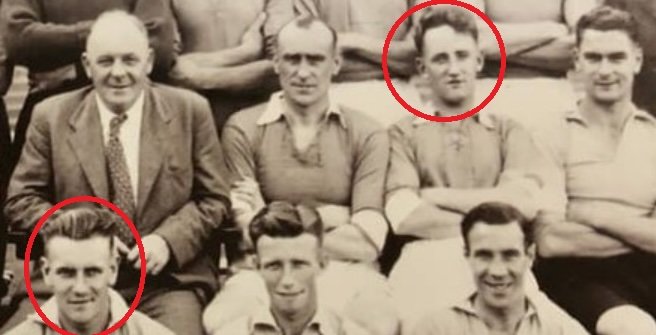 This is a response to a request I got from @SecretPro for some information about a friend whose grandfather played for Leicester just after World War 2 - a player called Bobbie Anderson. I was going to send a photo and a bit of background information, but as is so often the case, once you start looking into something, you find yourself tumbling down the rabbit hole and finding out all kinds of fascinating stuff. @SouthStandUpperTier, @davieG and @Rain King provided some useful info and a photo yesterday, but I thought I'd give this a thread all of its own as it really needs it to tell the story in full. June 1944 Leicester manager Tom Bromilow knew he had to start planning for the end of the War, which everyone was praying would come sooner rather than later. Unlike the first War, the club had not lost players in the fighting, but it had suffered massively in other ways. A German bomb had damaged the main stand (and German POWs had helped repair it). A fire had then completely ruined half of that stand and all the equipment inside, damage that the club couldn't afford to repair (and wouldn't have been allowed to anyway, with post-war resource shortages). The City Council then told them they may have to leave Filbert Street, with the land needed by the Electricity Board. And most of the club's directors had been banned for life after under-the-counter payments had been exposed. It was truly a dark hour. But Tom Bromilow knew he just had to get on with the job. He liked nothing better than getting on a train and heading for some far-off destination to seek out new talent. In June 1944, he went north, first to Glasgow, and then on his way back, to Middlesbrough. In Scotland he visited a club called Mearns Amateurs, and spotted a 15 year-old winger called Robert Anderson. In Middlesbrough, he saw our new nursery club Middlesbrough Swifts in action, and it was 16 year-old Donald Revie who caught his eye. Don, as he was known, and Bobbie (or sometimes 'Bobby'), as he was known, soon headed for trials at Filbert Street, and both impressed. Years later, Revie wrote about the moments after he first stepped off the train at Leicester Station: I wandered forlornly around Leicester with my football boots wrapped in brown paper under my arm. I walked round and round the shops, then hastily gulped down a cup of tea in a small café’. He was soon in action, wearing a City shirt for the first time in a 2-2 draw v Wolves at Filbert Street, the first game of the 1944/45 season, which was still organized into regional Leagues. Bobbie Anderson's arrival in the city may have been very similar, but in his case, the chance to play for Leicester would have to wait. He was an apprentice fitter-engineer, and it wasn't until January 1945 that he was fixed up with a company in Leicester where he could continue the apprenticeship. 1945/46 With the war over, football could get back to normal again. Though not immediately. The Football League decided that 1945/46 would be a transition season, still based on regional divisions. Leicester City had a new manager. Tom Bromilow had quit in March, and Tom Mather had just taken over. It can be unsettling when the man responsible for bringing you to a club suddenly moves on, but Mather knew a thing or two about wingers. When he was Stoke CIty manager in the early 1930s he had signed 15 year-old Stanley Matthews. On Saturday August 11th, Bobbie turned 17, and on that day Leicester City held their first post-war trial match, 'Blues v Whites', to see who would start the game at home to Charlton Athletic, scheduled for two weeks later. Bobbie and Don played in the trial, but only Don was selected for that first game, which Charlton won 3-2. The return match at The Valley a week later was also lost. Wondering who could freshen things up, Tom Mather went to watch Leicester Colts (the youth team) on Wednesday September 5th, with Bobbie in the line-up against Ibstock Penistone Rovers. He must have impressed Mather as the next day, the boss told him to join the first team squad for their third game of the season, away at Brentford. He was supposedly just along for the experience, but then left winger Fred Crack of Grimsby Town, due to turn out for us as a guest, was suddenly called back to his army base in Germany - which meant Bobbie Anderson's big moment had arrived. To call his first team debut 'sensational' would not be an exaggeration. This was the how the Daily News, then one of the leading national newspapers, reported the game: The Leicester Evening Mail called him a 'boy star', and said his teammates 'mobbed' him when he set up that first goal. Here's the Middlesex Chronicle, with an entertaining passage I'll quote at length: It was one of those affairs when one team exerts four-fifths of the pressure and the other lot snatch the goals. When Leicester full back Dai Jones, as a sort of advanced goalpost (and with no more intention than if he had indeed been one of those inanimate pillars) turned away a terrific smash by Les Smith, I thought it was going to be one of those days. That was a mere four minutes from the start, but the premonition was soon justified. When Leicester won a corner, the ball was most meticulously middled by Bobbie Anderson, and it was met by the head of Liddle to send it curling on a 12 yard journey into the net. It was 2-0 at the interval and in the second half the ball stayed in the City half for such long periods that the Bees might have been kicking down a one-in-three slope. A week later, that reporter was still writing about the same game: Many a young player has been ruined by too much fulsome praise, and we had an instance last week when Anderson, making his debut after a Colts' appearance the previous evening, was hailed by one writer, with the imagination of a film star's press agent, as Scotland's next Alan Morton. He made a most promising debut, but to start measuring him up for an international cap on the basis of one appearance is verging on the ridiculous. Let's hope the lad takes no notice. On the opposite wing that day was Don Revie, and supplying them both from the middle of the park was City legend Sep Smith, then in his 17th year at Filbert Street. Tom Mather certainly wasn't going to let the attention go to Bobbie's head. He chose him for just a handful of games that season, unlike Don Revie, who was becoming a regular, playing in the club's first FA Cup game for seven years, a third round defeat against Chelsea. 1946/47 The transition was over, and the Football League was finally back to normal. We had yet another new boss - Johnny Duncan, the wizard of Leicester's forward line in the 1920s who had since been running the Turk's Head pub, opposite the prison. Just like the previous season, we lost our first two games without Bobbie, then he came in for game three. In the record books, this is considered his 'real' Leicester City debut - the transitional season deemed 'unofficial'. Could he have the same impact as at Brentford? Once again, it was a tough-looking away game in London - at Upton Park. And once again, he was sensational. This was the Leicester Evening Mail: The same reporter added: Opportunities for Leicester became fewer later on, but the 17 year-old Scot with the twinkling feet and quick-thinking brain, never ceased to be a problem to the West Ham defence. 2-0 was the final score. Once again, though, this was only a brief flash of Bobbie's talent. He played a total of 13 games that season, without adding to his goal tally. Meanwhile, Don Revie was continuing to establish his reputation. 1947/48 A season of frustration for Bobbie (who made only six appearances, scoring once against Millwall) and for Revie, out for six months with a broken ankle that was so bad that doctors were almost certain he'd never play again. One bright spot for Bobbie came in a reserve game against Spurs: 1948/49 In the four years since Tom Bromilow's scouting trip brought them to Filbert Street, the careers of Bobbie and Don had gradually diverged. Revie had now made a miraculous recovery from his injury, and was an indispensable member of the City side that mounted a historic bid for the FA Cup this season, despite struggling at the wrong end of the Second Division. Bobbie's lot was very different. With the quarter-final approaching, he had not made a single first team appearance all season. But then suddenly he sensed an opportunity. That quarter-final was at a venue which held special memories for him - Griffin Park, Brentford. In the days leading up to the game, regular left winger Charlie Adam was struggling to be fit, and there was speculation in the press about who would replace him - Bobbie Anderson, or Jim Dawson (Bobbie's best mate). On the Friday morning, Adam passed a fitness test, but then just as it seemed Leicester would be able to field their regular forward line, Adam was handed a telegram from Scotland with dramatic news. His mother had been rushed to hospital and was 'dangerously ill'. The club were prepared to let him travel north, and it seemed that a replacement would be needed after all. But Adam insisted on playing, and he stayed with the Leicester squad. His mother died that night, and on Saturday, Adam lined up alongside Revie as City tried to reach the semi-finals for only the second time. Bobbie Anderson wasn't needed. This is what happened: Adam left for Scotland immediately after the final whistle. In the semi-final we shocked First Division leaders Portsmouth at Highbury (arguably our greatest ever result in the competition) - and so we had finally made it to Wembley. Don Revie then suffered a freak injury against West Ham, and this time it was not just his career but his life that was in danger. He had punctured a vein at the back of his nose, and he needed a series of blood transfusions at the Royal Infirmary to take him out of danger. There was no way he'd be ready for the Cup Final. As that was confirmed, just three days before the final, there was a milestone moment at Filbert Street - Sep Smith's last ever appearance on the ground, for the reserves against Bournemouth. Also playing that day was Bobbie Anderson, and it was his run from midfield that led to City being awarded a penalty, from which Sep Smith scored. He didn't know it then, but that was also Bobbie's last game at Filbert Street. Three days later, he was at Wembley to watch us lose heroically to Wolves, 3-1, while Don Revie was listening to radio commentary in his bed at the Infirmary. In the week following the Final, the local press had good and bad news about Bobbie. On Wednesday came reports that he was one of eight players placed on the transfer list. He was no longer wanted at Filbert Street. But somebody wanted him. The following day came news of Bobbie's engagement. The big day would be June 25th, and this was his bride-to-be: Here's Leicester Chronicle from July 2nd reporting on the wedding: Don Revie was planning his wedding too - his bride Elsie was the niece of Leicester boss Johnny Duncan. When another City player, Jimmy Harrison, married Doreen Shipman, daughter of the club chairman Len, he had been barracked by City fans, who suspected he was getting favourable treatment. Don didn't want to suffer the same fate, and told the club he wanted a transfer. In November 1949 he got his wish, with a move to Hull, though by then Duncan had moved on himself. So the Leicester careers of Don Revie and Bobbie Anderson overlapped almost exactly - arriving in summer 1944 and leaving early in the 1949/ 50 season. Revie went on to enjoy great success as player and manager, and to have numerous books and documentaries devoted to describing every moment of his life. Bobbie Anderson was almost completely forgotten, but as you can see from that post-war period in which he shone briefly yet brightly, his story is well worth telling.
 -
After The Darkest Hour, Two Youngsters Arrive To Offer New Hope
kushiro replied to kushiro's topic in Leicester City Forum
Cheers! -
After The Darkest Hour, Two Youngsters Arrive To Offer New Hope
kushiro replied to kushiro's topic in Leicester City Forum
I'll add a few extra bits that may be of some interest to Bobbie's grandson: This is from August 16th 1949: Then a few months later he went for a trial at Ipswich Town, who were then bottom of Division Three South (and would escape having to apply for re-election at the end of the season by just one point). He made at least one appearance for their reserves. This is from January 7th 1950: It seems that trial didn't work out. Then after spells at Whitwick Colliery and Third Lanark in Scotland, he made his most significant move, to Kilmarnock. A game from his time at Leicester may have had some influence on that signing. Bobbie's first game of 1947/48 was not until December 27th, when Brentford came to Filbert Street. These were the teams: Bobbie is there at outside left for City, which means his direct opponent would have been the Brentford right back - the number two. You can see that's a player called Macdonald. That was Malky Macdonald, the man who, four years later as manager of Kilmarnock, signed Bobbie. Here they are together in the match report from that Brentford game: The final score was 2-1 to Brentford, and no doubt Malky Macdonald remembered his fellow Scot from that game when the chance came to sign him for Killie. While at Kilmarnock, he was involved in a League Cup run that had echoes of Leicester's FA Cup exploits in 1949, though in this case, Bobbie actuallly got some playing time. At the start of that season, it seems he was playing the best football of his career, repeatedly singled out for prasie as Killie made it through the group stage to reach the League Cup quarter-finals: August 9th Kilmarnock 3 Alloa Athletic 1 Four days later, Dunfermline 3 Kilmarnock 4: August 23rd Alloa 0 Kilmarnock 1: Then in the quarter finals they got past St. Johnstone. This from the 2nd leg, September 17th: That put them in the semi-final v Rangers, a similar scenario to the Leicester v Portsmouth SF in 1949 - the eventual champions against the underdogs from the second tier (Killie would finish 4th in Division Two that season). Killie pulled off a famous giant killing act, winning 1-0 at Hampden. But for reasons I haven't been able to uncover, Bobbie wasn't in the line-up that day, nor did he play in the final, which they lost 2-0 to Dundee. Here's an excellent article about Malky Macdonald's career - he was a Celtic legend: MacDonald, Malcolm – The Celtic Wiki -
This is a response to a request I got from @SecretPro for some information about a friend whose grandfather played for Leicester just after World War 2 - a player called Bobbie Anderson. I was going to send a photo and a bit of background information, but as is so often the case, once you start looking into something, you find yourself tumbling down the rabbit hole and finding out all kinds of fascinating stuff. @SouthStandUpperTier, @davieG and @Rain King provided some useful info and a photo yesterday, but I thought I'd give this a thread all of its own as it really needs it to tell the story in full. June 1944 Leicester manager Tom Bromilow knew he had to start planning for the end of the War, which everyone was praying would come sooner rather than later. Unlike the first War, the club had not lost players in the fighting, but it had suffered massively in other ways. A German bomb had damaged the main stand (and German POWs had helped repair it). A fire had then completely ruined half of that stand and all the equipment inside, damage that the club couldn't afford to repair (and wouldn't have been allowed to anyway, with post-war resource shortages). The City Council then told them they may have to leave Filbert Street, with the land needed by the Electricity Board. And most of the club's directors had been banned for life after under-the-counter payments had been exposed. It was truly a dark hour. But Tom Bromilow knew he just had to get on with the job. He liked nothing better than getting on a train and heading for some far-off destination to seek out new talent. In June 1944, he went north, first to Glasgow, and then on his way back, to Middlesbrough. In Scotland he visited a club called Mearns Amateurs, and spotted a 15 year-old winger called Robert Anderson. In Middlesbrough, he saw our new nursery club Middlesbrough Swifts in action, and it was 16 year-old Donald Revie who caught his eye. Don, as he was known, and Bobbie (or sometimes 'Bobby'), as he was known, soon headed for trials at Filbert Street, and both impressed. Years later, Revie wrote about the moments after he first stepped off the train at Leicester Station: I wandered forlornly around Leicester with my football boots wrapped in brown paper under my arm. I walked round and round the shops, then hastily gulped down a cup of tea in a small café’. He was soon in action, wearing a City shirt for the first time in a 2-2 draw v Wolves at Filbert Street, the first game of the 1944/45 season, which was still organized into regional Leagues. Bobbie Anderson's arrival in the city may have been very similar, but in his case, the chance to play for Leicester would have to wait. He was an apprentice fitter-engineer, and it wasn't until January 1945 that he was fixed up with a company in Leicester where he could continue the apprenticeship. 1945/46 With the war over, football could get back to normal again. Though not immediately. The Football League decided that 1945/46 would be a transition season, still based on regional divisions. Leicester City had a new manager. Tom Bromilow had quit in March, and Tom Mather had just taken over. It can be unsettling when the man responsible for bringing you to a club suddenly moves on, but Mather knew a thing or two about wingers. When he was Stoke CIty manager in the early 1930s he had signed 15 year-old Stanley Matthews. On Saturday August 11th, Bobbie turned 17, and on that day Leicester City held their first post-war trial match, 'Blues v Whites', to see who would start the game at home to Charlton Athletic, scheduled for two weeks later. Bobbie and Don played in the trial, but only Don was selected for that first game, which Charlton won 3-2. The return match at The Valley a week later was also lost. Wondering who could freshen things up, Tom Mather went to watch Leicester Colts (the youth team) on Wednesday September 5th, with Bobbie in the line-up against Ibstock Penistone Rovers. He must have impressed Mather as the next day, the boss told him to join the first team squad for their third game of the season, away at Brentford. He was supposedly just along for the experience, but then left winger Fred Crack of Grimsby Town, due to turn out for us as a guest, was suddenly called back to his army base in Germany - which meant Bobbie Anderson's big moment had arrived. To call his first team debut 'sensational' would not be an exaggeration. This was the how the Daily News, then one of the leading national newspapers, reported the game: The Leicester Evening Mail called him a 'boy star', and said his teammates 'mobbed' him when he set up that first goal. Here's the Middlesex Chronicle, with an entertaining passage I'll quote at length: It was one of those affairs when one team exerts four-fifths of the pressure and the other lot snatch the goals. When Leicester full back Dai Jones, as a sort of advanced goalpost (and with no more intention than if he had indeed been one of those inanimate pillars) turned away a terrific smash by Les Smith, I thought it was going to be one of those days. That was a mere four minutes from the start, but the premonition was soon justified. When Leicester won a corner, the ball was most meticulously middled by Bobbie Anderson, and it was met by the head of Liddle to send it curling on a 12 yard journey into the net. It was 2-0 at the interval and in the second half the ball stayed in the City half for such long periods that the Bees might have been kicking down a one-in-three slope. A week later, that reporter was still writing about the same game: Many a young player has been ruined by too much fulsome praise, and we had an instance last week when Anderson, making his debut after a Colts' appearance the previous evening, was hailed by one writer, with the imagination of a film star's press agent, as Scotland's next Alan Morton. He made a most promising debut, but to start measuring him up for an international cap on the basis of one appearance is verging on the ridiculous. Let's hope the lad takes no notice. On the opposite wing that day was Don Revie, and supplying them both from the middle of the park was City legend Sep Smith, then in his 17th year at Filbert Street. Tom Mather certainly wasn't going to let the attention go to Bobbie's head. He chose him for just a handful of games that season, unlike Don Revie, who was becoming a regular, playing in the club's first FA Cup game for seven years, a third round defeat against Chelsea. 1946/47 The transition was over, and the Football League was finally back to normal. We had yet another new boss - Johnny Duncan, the wizard of Leicester's forward line in the 1920s who had since been running the Turk's Head pub, opposite the prison. Just like the previous season, we lost our first two games without Bobbie, then he came in for game three. In the record books, this is considered his 'real' Leicester City debut - the transitional season deemed 'unofficial'. Could he have the same impact as at Brentford? Once again, it was a tough-looking away game in London - at Upton Park. And once again, he was sensational. This was the Leicester Evening Mail: The same reporter added: Opportunities for Leicester became fewer later on, but the 17 year-old Scot with the twinkling feet and quick-thinking brain, never ceased to be a problem to the West Ham defence. 2-0 was the final score. Once again, though, this was only a brief flash of Bobbie's talent. He played a total of 13 games that season, without adding to his goal tally. Meanwhile, Don Revie was continuing to establish his reputation. 1947/48 A season of frustration for Bobbie (who made only six appearances, scoring once against Millwall) and for Revie, out for six months with a broken ankle that was so bad that doctors were almost certain he'd never play again. One bright spot for Bobbie came in a reserve game against Spurs: 1948/49 In the four years since Tom Bromilow's scouting trip brought them to Filbert Street, the careers of Bobbie and Don had gradually diverged. Revie had now made a miraculous recovery from his injury, and was an indispensable member of the City side that mounted a historic bid for the FA Cup this season, despite struggling at the wrong end of the Second Division. Bobbie's lot was very different. With the quarter-final approaching, he had not made a single first team appearance all season. But then suddenly he sensed an opportunity. That quarter-final was at a venue which held special memories for him - Griffin Park, Brentford. In the days leading up to the game, regular left winger Charlie Adam was struggling to be fit, and there was speculation in the press about who would replace him - Bobbie Anderson, or Jim Dawson (Bobbie's best mate). On the Friday morning, Adam passed a fitness test, but then just as it seemed Leicester would be able to field their regular forward line, Adam was handed a telegram from Scotland with dramatic news. His mother had been rushed to hospital and was 'dangerously ill'. The club were prepared to let him travel north, and it seemed that a replacement would be needed after all. But Adam insisted on playing, and he stayed with the Leicester squad. His mother died that night, and on Saturday, Adam lined up alongside Revie as City tried to reach the semi-finals for only the second time. Bobbie Anderson wasn't needed. This is what happened: Adam left for Scotland immediately after the final whistle. In the semi-final we shocked First Division leaders Portsmouth at Highbury (arguably our greatest ever result in the competition) - and so we had finally made it to Wembley. Don Revie then suffered a freak injury against West Ham, and this time it was not just his career but his life that was in danger. He had punctured a vein at the back of his nose, and he needed a series of blood transfusions at the Royal Infirmary to take him out of danger. There was no way he'd be ready for the Cup Final. As that was confirmed, just three days before the final, there was a milestone moment at Filbert Street - Sep Smith's last ever appearance on the ground, for the reserves against Bournemouth. Also playing that day was Bobbie Anderson, and it was his run from midfield that led to City being awarded a penalty, from which Sep Smith scored. He didn't know it then, but that was also Bobbie's last game at Filbert Street. Three days later, he was at Wembley to watch us lose heroically to Wolves, 3-1, while Don Revie was listening to radio commentary in his bed at the Infirmary. In the week following the Final, the local press had good and bad news about Bobbie. On Wednesday came reports that he was one of eight players placed on the transfer list. He was no longer wanted at Filbert Street. But somebody wanted him. The following day came news of Bobbie's engagement. The big day would be June 25th, and this was his bride-to-be: Here's Leicester Chronicle from July 2nd reporting on the wedding: Don Revie was planning his wedding too - his bride Elsie was the niece of Leicester boss Johnny Duncan. When another City player, Jimmy Harrison, married Doreen Shipman, daughter of the club chairman Len, he had been barracked by City fans, who suspected he was getting favourable treatment. Don didn't want to suffer the same fate, and told the club he wanted a transfer. In November 1949 he got his wish, with a move to Hull, though by then Duncan had moved on himself. So the Leicester careers of Don Revie and Bobbie Anderson overlapped almost exactly - arriving in summer 1944 and leaving early in the 1949/ 50 season. Revie went on to enjoy great success as player and manager, and to have numerous books and documentaries devoted to describing every moment of his life. Bobbie Anderson was almost completely forgotten, but as you can see from that post-war period in which he shone briefly yet brightly, his story is well worth telling.
- 8 replies
-
- 16
-

-

-
Jingle Bells, Jingle Bells, Jingle All The Way....
kushiro replied to kushiro's topic in Leicester City Forum
There's a lively discussion over on that other forum... https://www.bentleysroof.co.uk/index.php?threads/memories-of-brum.23428/ -
...oh what fun it is to see, the Leicester win away - at Birmingham - on the way to promotion. To help you through the long Monday hours before the game, here's a few merry St, Andrews memories: December 1st 1979: Jock Wallace's Leicester are lying 5th, Birmingham are 6th, but it's not like 2023/24. It's incredibly tight at the top, with both clubs just one point off the top. City fans arrive at St. Andrews to find out that Frank Worthington is making his Birmingham debut, with a guy called Steve Lynex dropped to the bench despite seven goals in his last 12 games. It wasn't a happy debut for Frank. We won 2-1, keeping up an amazing record of scoring in every League game so far that season. Alan Young and Martin Henderson got the goals with Gary Lineker, playing wide on the right, involved in both. Here's a section of Bill Anderson's match report: And this is a classic 1970s Mercury photo - amatuerishly super-imposing a mysterious spherical object so it looks like they're playing with a tennis ball: We won the return in April too, and in the end both sides went up - us as champions. January 28th 2014. No need for words here - just some classic action, as we set a new club record of eight wins in a row on the way to another table-topping season: November 26th 1995 Some fine action from the 'Mark McGhee is the Messiah' period, which lasted all of four months. Three weeks earlier we'd gone three up in no time at West Brom, and ended up winning 3-2. Now we take a quick two-goal lead at St, Andrews. Very nice of the 1995/96 season review editor to completely omit the Brummies' fight back. September 5th 1953 We've had 1979 and 2014, and here's a third 2-1 win at St. Andrews on the way to promotion as champions. This was a key early season result - we went into the game down in 10th, with Birmingham 3rd. It was a tale of two goalkeepers. Gil Merrick was then England's number one, depsite playing in Division Two. He would soon see six Hungarian goals fired past him at Wembley, then seven more in Budapest. But he kept his place for the World Cup Finals in Switzerland, where England were knocked out by holders Uruguay in the Quarter-final. Leicester keeper Johnny Anderson so nearly made it two second tier keepers at the Finals. He was perhaps our key player that season, more so even than Rowley and Hines in attack (the men who got the goals at Birmingham that day). Anderson was called up for his Scotland debut just two weeks before the World Cup kicked off, but in the end he was only a non-traveling reserve. Here he is in action that day at St. Andrews, challenging Ted Purdon then saving from a disbelieving Jackie Stewart: He would be a much more prominent figure in Leicester history had he not been overshadowed by the emergence of Banks and Shilton in the following decades. Another man who was being tipped for Scotland honours that season was our captain and centre-half - Matt Gillies. He didn't get a call-up in the end but finished the season with the Second Division Shield: Fans of spot-the-difference might notice something weird if you compare that photo and the one below, taken at the same sitting. In the one above, you can see John Anderson in his keeper's jersey behind Matt Gillies' left shoulder. But in the picture below it's clearly a different keeper (I think it's Adam Dickson). The most likely explanation is that Anderson was away with the Scotand squad, making that debut appearance I mentioned above. Slightly better quality photo-shopping (as it wasn't called then) than the Mercury example earlier. Manager Norman Bullock is front right. March 15th 1994 Birmingham CIty 0 Leicester City 3 on a Tuesday night. Brian Little's side finished 4th but then beat Derby in the play-off final. Somehow there is no footage of this game online (unless you know better...) We know from the Mercury report that 'Julian Joachim burst onto Iwan Roberts' pass in the ninth minute to leave the keeper helpless with a stunning finish that sent City fans into raptures'. Roberts and Ian Ormondroyd then added more. Steve Claridge came on as sub for Birmingham, to little effect. That result left them bottom of the table, and as we went up in May, they were heading in the opposite direction. Just for a year, though, in both cases. Time for a quick historical summary. In the 12 seasons in which we've been promoted to the top flight, we've played at St. Andrews in half of them. Of those six, we've won four, drawn two, lost none. The only one I've not mentioned is a 0-0 draw in October 1970, with Peter Shilton outstanding, just before he had a strop and put in a transfer request. Let's hope tonight is another to add to the list.
-
Test Thread - Post whatever you like as practice
kushiro replied to WigstonWanderer's topic in Forum Support
-
After Ipswich away August 73: After that, BR stopped running Football Specials from Leicester for a while.
-
Let's not forget Kirsty MacColl. Just like Roly Colahan, she was tragically killed in a boating accident, though the details were very different. https://en.wikipedia.org/wiki/Kirsty_MacColl#Death I hadn't realised that shortly before that accident, she'd written a song called 'England 2 Colombia 0', using that World Cup game in 1998 as a way to tell another story about unreliable blokes.
-
You probably know that there used to be a full Football League programme on Christmas Day. Leicester City's last ever fixture on December 25th was in 1957 - we lost 5-1 at Blackpool, with 42 year-old Stanley Matthews running riot on the right wing. Guess who was born on that very day. This fellow:
-
One day in 1997, after Leicester City decided they had to leave Filbert Street, Chief Executive Barrie Pierpoint was standing in a field in Aylestone, forming pictures in his mind. Above him ran Soar Valley Way, the road that leads from Glen Parva out towards the motorway. On the far side of the field, the River Soar was rolling gently along, separated from the canal by just a tiny slither of land. 'It's the perfect place for the new stadium', he thought. 'Easy access to the M1, not too far from the city centre, a beautiful spot'. It was one of several potential sites the club had identified after discussions with Leicester City Council. As he stood contemplating the club's future, Barrie was probably unaware of it, but on that very spot, 44 years earlier, one of the darkest episodes in the post-war history of Leicester was unfolding - and it was connected to his own family history. Around that time, Barrie's father changed the spelling of their name. It was originally 'Pierrepoint', but he decided to shorten it to 'Pierpoint', attempting to conceal the connection to a certain Albert Pierrepoint, a distant relative. Who was Albert Pierrepoint? He was the UK's most famous hangman, who carried out the last execution at Leicester Prison in 1953, after Irishman Joseph Reynolds was sentenced to death for murdering 12 year-old Janet Warner. This is what happened: May 22nd 1953 The football season had just finished, and despite Arthur Rowley topping the goalscoring charts, Leicester City had yet again failed to achieve their primary objective - promotion back to Division One. It was in the following days that Jospeh Reynolds began his macabre daily ritual. He was employed at Leicester Gas Works, just south of Filbert Street, and after work he would walk along the canal footpath to Aylestone, looking for a likely candidate. He spotted Dennis Goodger, who was on his way home to Gwencole Crescent, off Narborough Road, from the building job he was working on near the County Arms in Blaby. The next day, and for several days after that, Reynolds returned to the same spot along the canal, and each time he saw the same man. Finally, on May 22nd, he was ready. When Goodger walked past that day, he would put his plan into action. But Goodger didn't turn up. Fortunately for him, his job in Blaby had finished the day before. The plan was stymied. Tragically for Janet Warner, Reynolds quickly decided to find an alternative victim. She was strangled, and her body dumped near the canal in Glen Parva. Reynolds was soon arrested, and sentenced to death five months later. On November 17th, a scene that had been observed many times over the previous 100 years played out for the last time - a large crowd gathering outside the walls of Leicester Prison, awaiting confirmation of the execution. Among them was none other than Dennis Goodger, who spoke to a reporter from the Leicester Evening Mail about his narrow escape. 'He was there every day at the same place. And he always asked me the time. Every day I gave the same answer: 'It's just turned five o'clock'. He used to give me a strange out-of-this-world look and I became more and more suspicious'. At 9.10 a.m. the chief warder opened the main gates of the prison and pinned up the notice stating that the sentence of death had been carried out. 'Pierrepoint', the Mail said, 'was the executioner'. That's how people referred to him. He didn't need a first name - everyone knew who he was. It had been nine years since the previous execution in the city, a double hanging in 1944. Albert Pierrepoint was there that day too, and he might have been busier in the intervening years had it not been for the efforts of one man. That was Dr. Arthur Colahan, an Irishman from Galway who had worked in Leicester since the 1920s. He was often called to murder trials to offer his expert opinion on the sanity or otherwise of the accused. On one particular occasion, that evidence proved crucial. Saturday January 24th 1948 It was a huge day for Leicester City - drawn at home against Sheffield Wednesday in the Fourth Round of the FA Cup. At 2 p.m., supporters heading to Filbert Street from the city centre may not have paid too much attention to a taxi picking up two passengers at the Grand Hotel. Josef Zawadaski and his former partner Joan Mills told the driver to take them to Kitchener Road near Spinney Hill Park. At Filbert Street, far more than the usual number of police were on duty. They had been struggling to keep order for several hours as huge numbers gathered, excited by the prospect of a Cup run, and perhaps Leicester's first visit to Wembley. Half an hour before kick-off the gates were closed, leaving thousands outside. One entrance at the Spion Kop end was then smashed and fans surged into the ground without paying. Police somehow managed to form a barrier and prevent even more getting in. This was how Filbert Street had looked at 12.30: Calls may have been made to Charles Street police HQ, asking for reinforcements, but just at that moment it became apparent that a drama of a different nature was unfolding across town in Kitchener Road. When that taxi arrived, Zawadski suddenly produced a gun. He shot Mills, killing her instantly, then tried to shoot himself in the head, but failed. At Filbert Street, Leicester beat Sheffield Wednesday 2-1 with two famous goals - Walter Harrison after a '40 yard dribble' and Jimmy Haines from 25 yards. In the local papers on Monday two stories dominated - the fall-out from the shooting on Kitchener Road, and the draw for the last 16 of the FA Cup. Leicester were given a tie away to fellow Second Division side Tottenham Hotspur. By the time Zawadski's case came to trial on March 16th, Leicester were out of the Cup. They would have to wait another year for their first ever visit to Wembley. In court, Dr. Arthur Colahan testified that at the time of the shooting, he believed that Zawadski was suffering from 'manic depressive anxiety'. His evidence was crucial - without it, Zawadski would have been given the death penalty, and Pierrepoint would have been back in town. In fact, this was not the first time Dr. Colahan had played such a role. Before that double hanging in 1944 mentioned above, he had testified on behalf of one of the defendants, William Cowie, who was suffering, he said, from 'depressive insanity'. But on this occasion his testimony couldn't prevent a death sentence being handed down, and Pierrepoint was called for (at that time, as an assistant, with his uncle Thomas in charge shortly before he retired). Back in 1931 Dr. Colahan had testified on behalf of Annie Robson, a Leicester nurse charged with the murder of a patient. He said he had interviewed her in prison and declared her 'insane'. The jury found her guilty, but due to her insanity, she escaped the death penalty. So that's three occasions over a period of 17 years when he tried to save someone from the noose. It's tempting to think that, above any considerations about a defendant's state of mind, Dr. Colahan was motivated simply by an abhorrence of the death penalty. Maybe he simply wanted to save lives. When you look at his life story, it's easy to see why that would have meant so much to him. August 17th 1912 Long before Arthur Colahan left Ireland and came to Leicester to begin his medical practice, his brother Roly lost his life in a tragic accident on Lough Corrib in County Galway. Roly and his friend Oswald Fisher went out in a sailing boat in windy conditions, and the vessel was quickly in trouble. A strong gust blew the boat over on its side, and the two stripped naked and dived into the water, several hundred yards from the shore. The heartbreaking story of what happened next appeared in the Galway Express: That's how Arthur Colahan lost his brother. Several years later, after he moved to Leicester, he wrote a song dedicated to Roly's memory, the lyrics full of allusions to the tragedy on Lough Corrib. He called the song Galway Bay. It became a massive hit in Ireland, the UK and the USA. This is the Leicester Evening Mail from May 1948: Arthur Colahan died in 1952. Now another great Irish songwriter has died, and his song, which tips its hat to the boys of the NYPD choir and to Colahan's song, is everywhere (even more so than usual). Colahan isn't short of recognition either. This is his plaque in Prebend Street:
- 15 replies
-
- 27
-
-
-
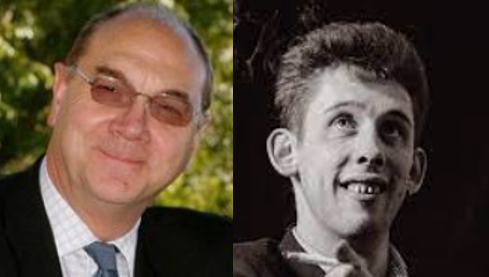 One day in 1997, after Leicester City decided they had to leave Filbert Street, Chief Executive Barrie Pierpoint was standing in a field in Aylestone, forming pictures in his mind. Above him ran Soar Valley Way, the road that leads from Glen Parva out towards the motorway. On the far side of the field, the River Soar was rolling gently along, separated from the canal by just a tiny slither of land. 'It's the perfect place for the new stadium', he thought. 'Easy access to the M1, not too far from the city centre, a beautiful spot'. It was one of several potential sites the club had identified after discussions with Leicester City Council. As he stood contemplating the club's future, Barrie was probably unaware of it, but on that very spot, 44 years earlier, one of the darkest episodes in the post-war history of Leicester was unfolding - and it was connected to his own family history. Around that time, Barrie's father changed the spelling of their name. It was originally 'Pierrepoint', but he decided to shorten it to 'Pierpoint', attempting to conceal the connection to a certain Albert Pierrepoint, a distant relative. Who was Albert Pierrepoint? He was the UK's most famous hangman, who carried out the last execution at Leicester Prison in 1953, after Irishman Joseph Reynolds was sentenced to death for murdering 12 year-old Janet Warner. This is what happened: May 22nd 1953 The football season had just finished, and despite Arthur Rowley topping the goalscoring charts, Leicester City had yet again failed to achieve their primary objective - promotion back to Division One. It was in the following days that Jospeh Reynolds began his macabre daily ritual. He was employed at Leicester Gas Works, just south of Filbert Street, and after work he would walk along the canal footpath to Aylestone, looking for a likely candidate. He spotted Dennis Goodger, who was on his way home to Gwencole Crescent, off Narborough Road, from the building job he was working on near the County Arms in Blaby. The next day, and for several days after that, Reynolds returned to the same spot along the canal, and each time he saw the same man. Finally, on May 22nd, he was ready. When Goodger walked past that day, he would put his plan into action. But Goodger didn't turn up. Fortunately for him, his job in Blaby had finished the day before. The plan was stymied. Tragically for Janet Warner, Reynolds quickly decided to find an alternative victim. She was strangled, and her body dumped near the canal in Glen Parva. Reynolds was soon arrested, and sentenced to death five months later. On November 17th, a scene that had been observed many times over the previous 100 years played out for the last time - a large crowd gathering outside the walls of Leicester Prison, awaiting confirmation of the execution. Among them was none other than Dennis Goodger, who spoke to a reporter from the Leicester Evening Mail about his narrow escape. 'He was there every day at the same place. And he always asked me the time. Every day I gave the same answer: 'It's just turned five o'clock'. He used to give me a strange out-of-this-world look and I became more and more suspicious'. At 9.10 a.m. the chief warder opened the main gates of the prison and pinned up the notice stating that the sentence of death had been carried out. 'Pierrepoint', the Mail said, 'was the executioner'. That's how people referred to him. He didn't need a first name - everyone knew who he was. It had been nine years since the previous execution in the city, a double hanging in 1944. Albert Pierrepoint was there that day too, and he might have been busier in the intervening years had it not been for the efforts of one man. That was Dr. Arthur Colahan, an Irishman from Galway who had worked in Leicester since the 1920s. He was often called to murder trials to offer his expert opinion on the sanity or otherwise of the accused. On one particular occasion, that evidence proved crucial. Saturday January 24th 1948 It was a huge day for Leicester City - drawn at home against Sheffield Wednesday in the Fourth Round of the FA Cup. At 2 p.m., supporters heading to Filbert Street from the city centre may not have paid too much attention to a taxi picking up two passengers at the Grand Hotel. Josef Zawadaski and his former partner Joan Mills told the driver to take them to Kitchener Road near Spinney Hill Park. At Filbert Street, far more than the usual number of police were on duty. They had been struggling to keep order for several hours as huge numbers gathered, excited by the prospect of a Cup run, and perhaps Leicester's first visit to Wembley. Half an hour before kick-off the gates were closed, leaving thousands outside. One entrance at the Spion Kop end was then smashed and fans surged into the ground without paying. Police somehow managed to form a barrier and prevent even more getting in. This was how Filbert Street had looked at 12.30: Calls may have been made to Charles Street police HQ, asking for reinforcements, but just at that moment it became apparent that a drama of a different nature was unfolding across town in Kitchener Road. When that taxi arrived, Zawadski suddenly produced a gun. He shot Mills, killing her instantly, then tried to shoot himself in the head, but failed. At Filbert Street, Leicester beat Sheffield Wednesday 2-1 with two famous goals - Walter Harrison after a '40 yard dribble' and Jimmy Haines from 25 yards. In the local papers on Monday two stories dominated - the fall-out from the shooting on Kitchener Road, and the draw for the last 16 of the FA Cup. Leicester were given a tie away to fellow Second Division side Tottenham Hotspur. By the time Zawadski's case came to trial on March 16th, Leicester were out of the Cup. They would have to wait another year for their first ever visit to Wembley. In court, Dr. Arthur Colahan testified that at the time of the shooting, he believed that Zawadski was suffering from 'manic depressive anxiety'. His evidence was crucial - without it, Zawadski would have been given the death penalty, and Pierrepoint would have been back in town. In fact, this was not the first time Dr. Colahan had played such a role. Before that double hanging in 1944 mentioned above, he had testified on behalf of one of the defendants, William Cowie, who was suffering, he said, from 'depressive insanity'. But on this occasion his testimony couldn't prevent a death sentence being handed down, and Pierrepoint was called for (at that time, as an assistant, with his uncle Thomas in charge shortly before he retired). Back in 1931 Dr. Colahan had testified on behalf of Annie Robson, a Leicester nurse charged with the murder of a patient. He said he had interviewed her in prison and declared her 'insane'. The jury found her guilty, but due to her insanity, she escaped the death penalty. So that's three occasions over a period of 17 years when he tried to save someone from the noose. It's tempting to think that, above any considerations about a defendant's state of mind, Dr. Colahan was motivated simply by an abhorrence of the death penalty. Maybe he simply wanted to save lives. When you look at his life story, it's easy to see why that would have meant so much to him. August 17th 1912 Long before Arthur Colahan left Ireland and came to Leicester to begin his medical practice, his brother Roly lost his life in a tragic accident on Lough Corrib in County Galway. Roly and his friend Oswald Fisher went out in a sailing boat in windy conditions, and the vessel was quickly in trouble. A strong gust blew the boat over on its side, and the two stripped naked and dived into the water, several hundred yards from the shore. The heartbreaking story of what happened next appeared in the Galway Express: That's how Arthur Colahan lost his brother. Several years later, after he moved to Leicester, he wrote a song dedicated to Roly's memory, the lyrics full of allusions to the tragedy on Lough Corrib. He called the song Galway Bay. It became a massive hit in Ireland, the UK and the USA. This is the Leicester Evening Mail from May 1948: Arthur Colahan died in 1952. Now another great Irish songwriter has died, and his song, which tips its hat to the boys of the NYPD choir and to Colahan's song, is everywhere (even more so than usual). Colahan isn't short of recognition either. This is his plaque in Prebend Street:
 -
This needs an update following the publication of Gordon's book. I didn't know when I posted this that Gordon and Jock were really good friends, and Jock would often head over to Highfield Road with Assistant Manager Ian MacFarlane for a chat when he was boss at Filbert Street. Gordon recalls Jock's knock on his door as 'like a sledgehammer' and that his two guests would then enter the room, making him feel 'like the KGB were in town'. Then Jock would shake Gordon's hand and he'd feel like he'd got 'three broken fingers'. Marvelous stuff. It brings to mind that character from the 80s TV series 'Boys From The Blackstuff' - 'Shake Hands': The book's full of great passages like that (it's an excellent choice for a Christmas present for those struggling for ideas).
-
Test Thread - Post whatever you like as practice
kushiro replied to WigstonWanderer's topic in Forum Support
-
Last night Villa won their 14th home game in a row, equaling the club record. The last time they did it was 1931. It was on October 24th 1931 that the run ended - Everton won 3-2 at Villa Park. Also on that day another run started. Jimmy Dunne scored for Sheffield United in their win at Grimsby - and he would score in each of their next eleven games too. That set the all time record for the top flight. It was so nearly equaled in 2015 by Jamie Vardy.
-
Seems a good moment to bump this for anyone who missed it in the summer. His dash on to the Hawthorns pitch today when Harry got the winner was a throwback to his goal celebrations in 1998/99.
-
A few more things to say about that game. Jock asked Tommy Williams to do a marking job on Howard Kendall. Stoke manager Alan Durban had rested striker Garth Crooks that day, but later that year Crooks came back to Filbert Street and scored a hat-trick for England U-21 against Bulgaria on a night when he was racially abused repeatedly (the kind of thing that led to Rock Against Racism being formed). Gary Lineker was one of the youngsters Jock threw in that season, but he wasn't in the line-up that day. His debut was on New Year's Day but he hadn't made the impact of Dave Buchanan. His second appearance for City would come a week after the Stoke game, and in the game after that he scored the crucial goal at Notts County that removed any lingering worries about relegation. Speaking of Notts County, Stoke went to Meadow Lane on the final day of the season needing a win to go up - and with 14,000 away fans backing them they had to wait until two minutes from time for the goal that took them up. Three days after that, we rounded off our season with a 2-2 draw at Bramall Lane, a game United needed to win by nine clear goals to stay up. That was the youngest team we'd ever fielded in a senior game.
-
It's so great when a new piece of ancient Leicester City footage suddenly appears online - especially when it's as good as this clip, uploaded just a couple of weeks ago by 'The Free Football Library'. I discovered it totally by accident. I was reading up about the Rock Against Racism concert at the De Montfort Hall on April 9th 1979 and in the Mercury that day was a report on Leicester City 1 Stoke City 1. This was in Jock Wallace's first season, when despite struggling near the bottom of Division Two, the fans were totally on his side as he'd thrown in a group of youngsters who were playing attractive, if not always winning football. Bill Anderson was heaping on the praise in his match report, and described our goal like this: Goodwin sliced his way through from midfield, found Smith who then put Buchanan through to beat Jones magnificently. It sounded like a really interesting game so I tried to find out more - and the first piece that came up in the archive search was 'ATV 2.25pm: Star Soccer. Leicester CIty v Stoke CIty'. Wow - it was on telly. I thought I'd seen all the available match action from that season, and I couldn't remember this one. A quick youtube search revealed this footage - just uploaded, with only nine people having watched it so far. It deserves a much wider audience. That goal is even better than Bill Anderson described it. We're knocking it around confidently like 1972 Leeds United, and then the Goodwin / Smith / Buchanan link up totally pulls the Stoke defence apart. You might have noticed Geoff Scott in the Stoke defence. Jock brought him to Filbert Street the following season. But this wasn't his finest moment. He is utterly defeated by Bobby Smith' s movement in the build up to the goal. Smith is in a central striker's position, but as we build up the move, he comes deep. Scott is caught in the classic centre half dilemma - do I follow him or hold my ground? He decided to go with his man, but as Goodwin slices through, Scott leaves Smith and makes a forlorn attempt to tackle the Leicester midfielder. Scott's actions have left two things completely open - Bobby Smith, and the middle of the Stoke defence, in which there is now a massive hole. It's like chess. All it requires now for a kill is for Goodwin to find Smith, and for Smith to find Buchanan, who is running into that vacated central position. Those two moves are executed perfectly, and so is the finish. What a ****ing goal. That was the verve that kept the fans right behind Jock despite the struggles, and which would take us to promotion the following season.
-
This is a good piece: Frank Soo: England's pioneer who died with a tale untold - BBC Sport
-
14. Didn't get the German one.
-
City of Leicester & Leicestershire - The Good and Historical Stuff
kushiro replied to davieG's topic in General Chat
Continuing the Belgrave Road theme, here you can see a great view of those terraced streets from 1939, with the River Soar running down the left hand side, Marjorie Street parallel to it at the bottom, and the site of our ground in 1887/88 marked.