Our system detected that your browser is blocking advertisements on our site. Please help support FoxesTalk by disabling any kind of ad blocker while browsing this site. Thank you.
Jump to content

leicsmac

Member
  • Posts

    30,136
  • Joined

  • Last visited

  • Days Won

    2

Everything posted by leicsmac

  1. You would have thought this was obvious from the start.
  2. Well, you would think it would be self evident, yes, but sadly it would appear not. With respect to the general point being made here, it is a valid point but it's been made multiple times before, at length, and always seems a mite like both a deflection and a capitulation. We absolutely require solutions to mitigate a worst case scenario as described here, but quite frankly the consequences of that will be so severe that catastrophic damage will be done to life and infrastructure, no matter what we might do. We can perhaps do our best to limit the amount of bodies that will pile up, but there will still be plenty of them. So, yes, while we should devote time and attention to mitigation, considering that to be our best or only option is not only accepting the deaths of a truly massive amount of life, but also pretty much guaranteeing that prophecy will be self fulfilling through lack of effort. Future generations won't look at the why - they'll just say we all killed the world, and they'd be right to. So unless and until that is someone's idea of a morally acceptable time, then prevention, even to a small degree that might save a few lives, must be the priority, with mitigation a consideration, but only to be used when all other options are absolutely and categorically exhausted.
  3. Sony and PSN are absolutely bloody useless for things like this. I've had to try to restore access to my own account in the past and it was a nightmare. You have my sympathy, I just hope you can get access to everything restored quickly. Another argument for using 2FA as much as possible where possible.
  4. This deserves a full copy and paste here for the sake of everyone reading it. It is spot on. Last autumn, a UK government report warned that climate-driven ecosystem collapse could lead to food shortages, mass migration, political extremism and even nuclear conflict. The report was never officially launched. Commissioned by Defra—the Department for Environment, Food and Rural Affairs—and informed by intelligence agencies including MI5 and MI6, the briefing assessed how environmental degradation could affect UK national security. At the last minute, the launch was canceled, reportedly blocked by Number 10. Thanks to pressure from campaigners and a freedom of information request, a 14-page version of the report was snuck out (no launch, not even a press release) on January 22. That report says, "Critical ecosystems that support major food production areas and impact global climate, water and weather cycles" are already under stress and represent a national security risk. If they failed, the consequences would be severe: water insecurity, severely reduced crop yields, loss of arable land, fisheries collapse, changes to global weather patterns, release of trapped carbon exacerbating climate change, novel zoonotic disease and loss of pharmaceutical resources. In plainer terms, the UK would face hunger, thirst, disease and increasingly violent weather. An unredacted version of the report, seen by the Times, goes further. It warns that the degradation of the Congo rainforest and the drying up of rivers fed by the Himalayas could drive people to flee to Europe (Britain's large south Asian diaspora would make it "an attractive destination"), leading to "more polarized and populist politics" and putting more pressure on national infrastructure. The Times describes a "reasonable worst case scenario" in the report, where many ecosystems were "so stressed that they could soon pass the point where they could be protected." Declining Himalayan water supplies would "almost certainly escalate tensions" between China, India and Pakistan, potentially leading to nuclear conflict. Britain, which imports 40% of its food, would struggle to feed itself, the unredacted report says. The report isn't an outlier, and these concerns are not confined to classified briefings. A 2024 report by the University of Exeter and think-tank IPPR warned that cascading climate impacts and tipping points threaten national security—exactly the risk outlined in the Defra report. The government has not publicly explained why the launch was canceled. In response to the Times article, a Department for Environment, Food and Rural Affairs spokesperson said, "Nature underpins our security, prosperity and resilience, and understanding the threats we face from biodiversity loss is crucial to meeting them head on. The findings of this report will inform the action we take to prepare for the future." Perhaps there are mundane reasons to be cautious about a report linked to the intelligence services that warns of global instability. But the absence of any formal briefing or ministerial comment is itself revealing—climate risks appear to be treated differently from other risks to national security. It's hard to imagine a report warning of national security risks from AI, China or ocean piracy getting the same treatment. This episode is not even especially unusual, historically. Governments have been receiving warnings about climate change—and downplaying or delaying responses—for decades. In January 1957, the Otago Daily Times reported a speech by New Zealand scientist Athol Rafter under the headline "Polar Ice Caps May Melt With Industrialisation." Rafter was merely repeating concerns already circulating internationally, including by a Canadian physicist whose similar warning went around the world in May 1953. Climate change first went viral more than seven decades ago. By the early 1960s, scientists were holding meetings explicitly focused on the implications of carbon dioxide buildup. In 1965, a report to the US president's Science Advisory Council warned that "marked changes in climate, not controllable through local or even national efforts, could occur." Senior figures in the UK government were aware of these discussions by the late 1960s, while the very first environment white paper, in May 1970, mentions carbon dioxide build-up as a possible problem. But the story we see today was the same. Reports are commissioned, urgent warnings are issued—and action is deferred. When climate change gained renewed momentum in the mid-1980s, following the discovery of the ozone hole and the effects of greenhouse gases besides carbon dioxide, the message sharpened: Global warming will come quicker and hit harder than expected. Margaret Thatcher finally acknowledged the threat in a landmark 1988 speech to the Royal Society. But when green groups tried to get her to make specific commitments, they had little success. Since about 1990, the briefings have barely changed. Act now, or suffer severe consequences later. Those consequences, however, are no longer theoretical. Why does nothing happen? Partly, it's down to inertia. We have built societies in which carbon-intensive systems are locked in. Once you've built infrastructure around, say, the private petrol-powered automobile, it's hard for competitors to offer an alternative. There's also a mental intertia: It's hard to let go of assumptions you grew up with in a more stable era. Secrecy plays a role too. As the Defra report illustrates, uncomfortable assessments are often softened, delayed or buried. Then, if you do accept the need for action, you are then up against the problem of responsibility being fragmented across sectors and institutions, making it hard to know where to aim your efforts. Meanwhile, social movements fighting for climate action find it hard to sustain momentum for more than three years. Here's the final irony. Conspiracy theorists and climate deniers insist governments are exaggerating the threat. In reality, the evidence increasingly suggests the opposite. Official assessments tend to lag behind scientific warnings, and the most pessimistic scenarios are often confined to technical or classified documents. The situation is not better than we are told. It's actually far worse. This is the reality, people. Denial will get you no place but the void. Along with a great proportion of our species and all species.
  5. Very disappointing blowout after dominating the group stage, that.
  6. Hope not. He's the best - perhaps the only - option.
  7. https://www.bbc.co.uk/news/articles/ce8rl71n4r3o Interesting piece on one of the leading sociopaths somewhat behind the curtain in the US, Stephen Miller. A much more balanced report than the man likely deserves.
  8. https://phys.org/news/2026-02-climate-fingerprints-human-atmosphere-bottom.html The world is warming. This fact is most often discussed for Earth's surface, where we live. But the climate is also changing from the top of the atmosphere to the bottom of the ocean. And there is a clear fingerprint of humanity's role in causing these changes through greenhouse gas emissions, primarily from burning fossil fuels. Over the last several decades, satellites have monitored Earth and measured how much heat enters and leaves the atmosphere. Over that time, as greenhouse gas concentrations have increased in the atmosphere, there has been less heat escaping into space, causing an imbalance with more heat being retained. The consequence is a rapidly heating planet. And may those who come after us either cherish us for somehow doing the right thing to turn things round, or forgive us for giving to them a world vastly less capable of sustaining their life, and all life.
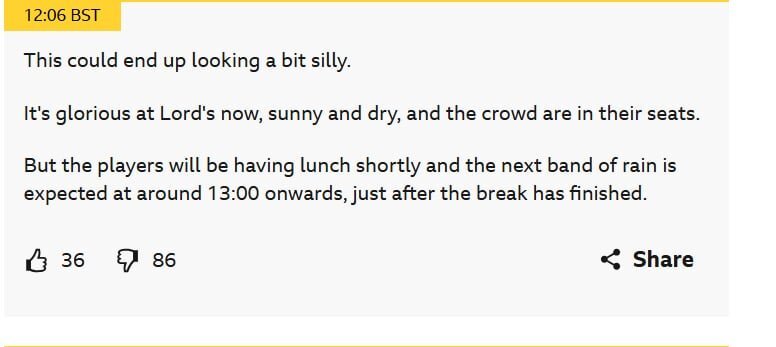
  9. An 11 ball over that had 19 runs and two wickets. It's all certainly happening.
  10. And thank you for a superb example of the False Premise Fallacy. But I fear we're veering somewhat off topic here.
  11. The examples used show that the creator might have an axe to grind, but the basic explanation of the fallacy itself is sound, which is what I was looking for. Especially when there was such a blatant use of said fallacy.
  12. Curran probably saved the day with that over. Far closer that it needs to be, though.
  13. They're scoring at a comfortable enough rate. Probably around 250 and then it will be up to the bowlers to see how good the NRR win can be.
  14. https://www.bbc.co.uk/weather/articles/cvgdg475d4po More record breaking.
  15. That's the thing about jury nullification, it cuts all kinds of ways.
  16. And consider the cake iced.
  17. Not entirely sure about that one being ruled out, either, so I guess it's even.
  18. Not entirely sure that's a penalty try tbh. Little bit harsh.
  19. With added Oversimplified Cause Fallacy for good effect too. We've got more logical fallacies than City red cards going on right now, it would appear.
  20. Well, the above being said, if there's many more gift wrapped tries given out like that...
  21. Sometimes you do wonder why you bother. NB. Don't think this will be a record score, but it will be pretty crushing.
  22. Purely for the record here for anyone who might be viewing: https://www.logicallyfallacious.com/questions/tmIKpkV5/the_motteandbailey_fallacy.html Motte and Bailey is an interesting fallacy.
  23. One of those rare situations where I want India to hand out a thrashing without any other conditions.
×
×
  • Create New...